Auctane CRO Program
A systematic A/B testing program across ShipStation and Stamps.com, focused on trial and registration conversion. Each test built on the prior one, eventually surfacing a durable insight that now drives the strategy: ICP and non-ICP users require fundamentally different experiences.
Top Results
How Tests Were Run
All tests ran through Optimizely with traffic segmented by ICP (high-volume enterprise shippers) and non-ICP (SMB users), and further broken out by channel: Direct, Organic, Campaign, Referral, and Paid. That granularity exposed patterns that aggregate results would have buried.
The Pattern That Emerged
What converts enterprise shippers tends to hurt smaller businesses, and vice versa. ICP users (high-volume, often evaluating for a team) responded to app UI, feature depth, and value-forward copy. Non-ICP users needed social proof, simplicity, and trust signals. Tests that lifted both simultaneously were the exception.
ShipStation: Homepage
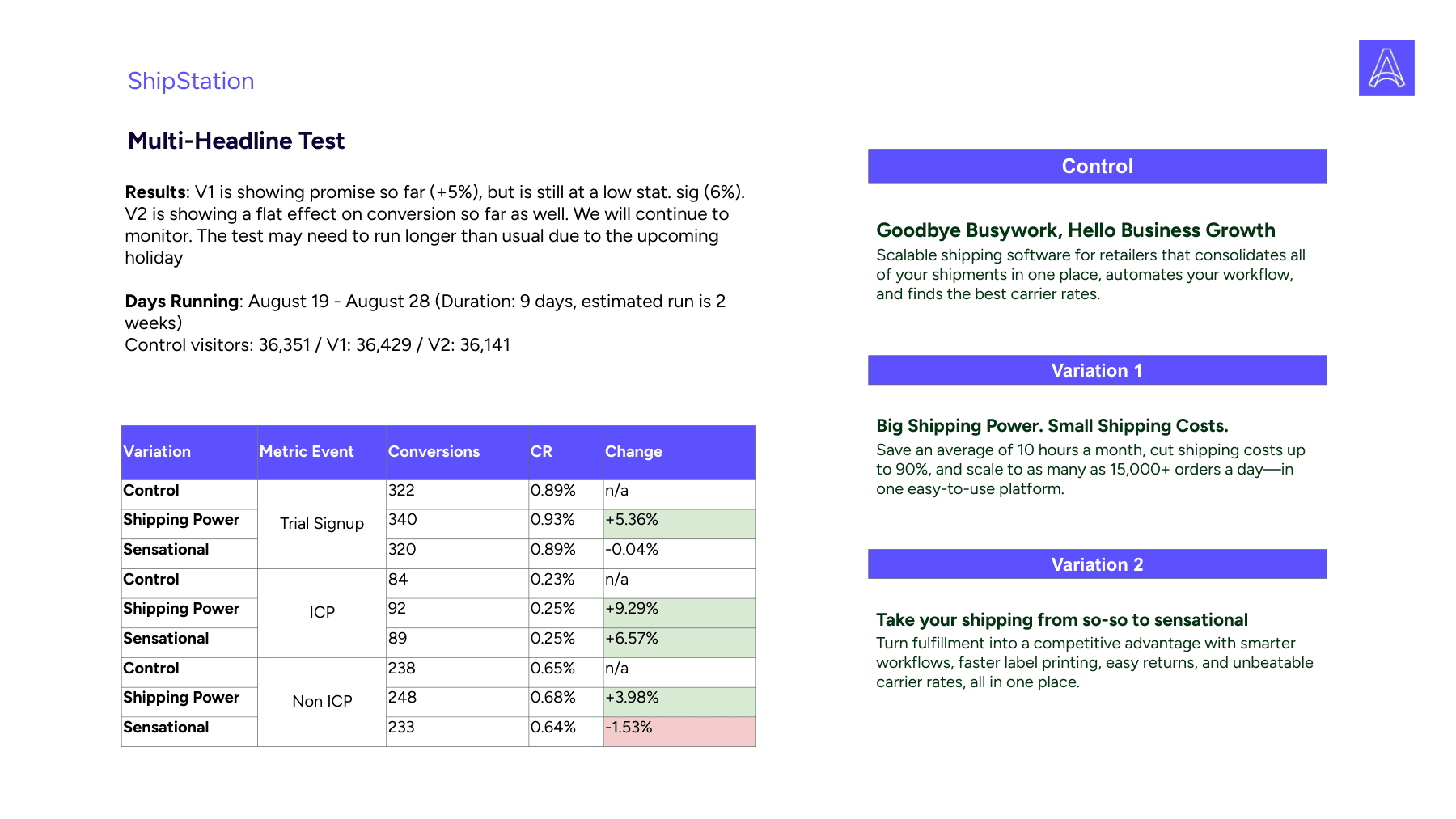
Multi-Headline Test
Aug 19 – 28, 2025 · 9 days · 108K visitors
Hypothesis
Testing three headline variants ("Goodbye Busywork, Hello Business Growth," "Big Shipping Power. Small Shipping Costs.," and "Take your shipping from so-so to sensational") to identify which messaging frame converts best.
Results & Learning
"Big Shipping Power. Small Shipping Costs." showed +5.4% overall trial lift with +9.3% ICP, the strongest individual result across all homepage copy tests. The aspirational "sensational" variant was flat. "Shipping Power" became the established control for subsequent redesign tests.
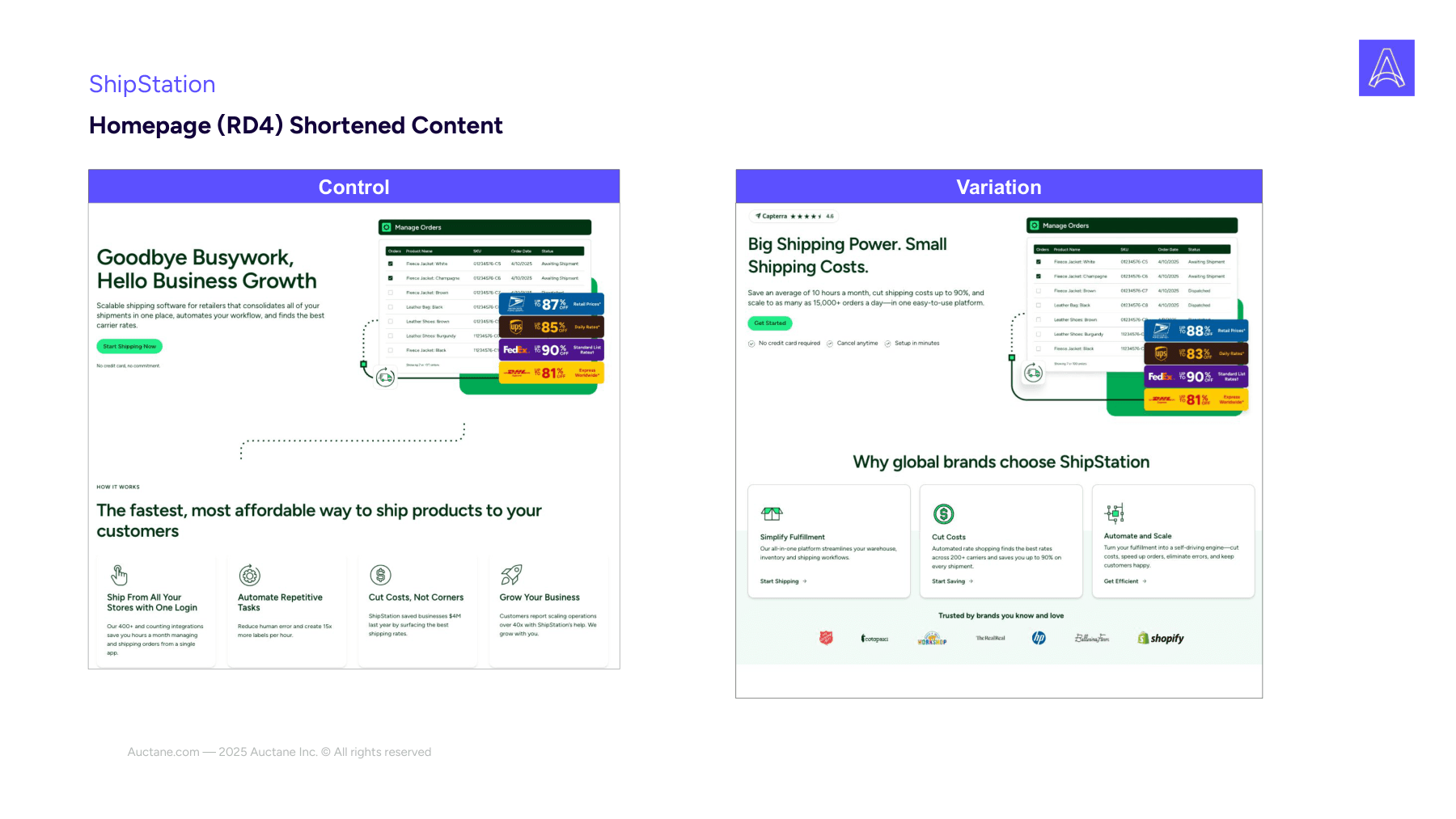
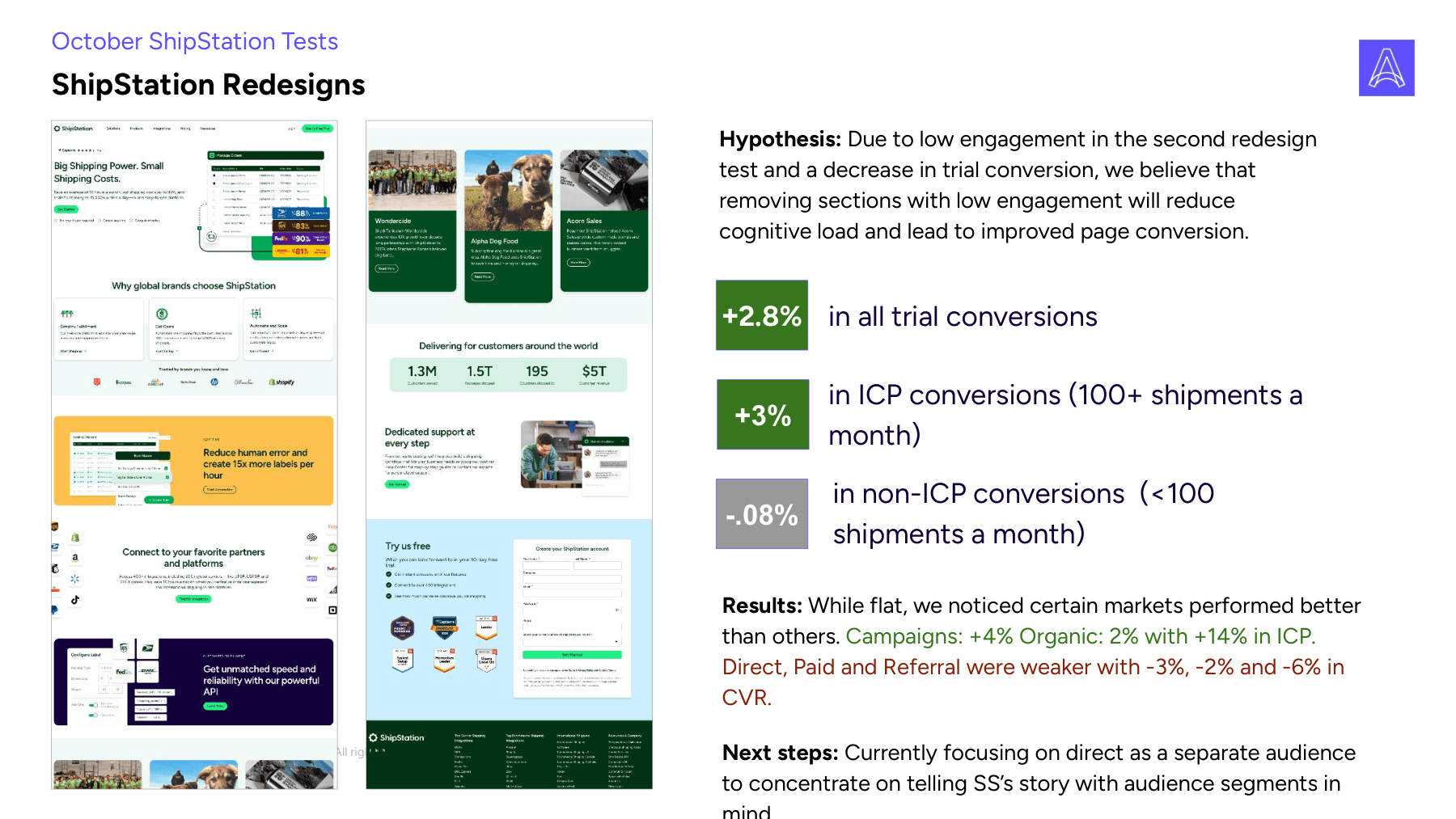
RD4: Shortened Content
October 2025 · 21 days
Hypothesis
Removing low-engagement sections identified in the RD2 heatmap would reduce cognitive load and improve page conversion.
Results & Learning
+2.8% all trial conversions, non-ICP +3.7%. ICP marginally worse (-0.85%). Channel breakdown revealed more signal: Campaigns +4%, Organic +14% ICP. Direct, Paid, and Referral traffic performed worse (-3%, -2%, -6%). Established channel-level segmentation as a required lens for all future tests.
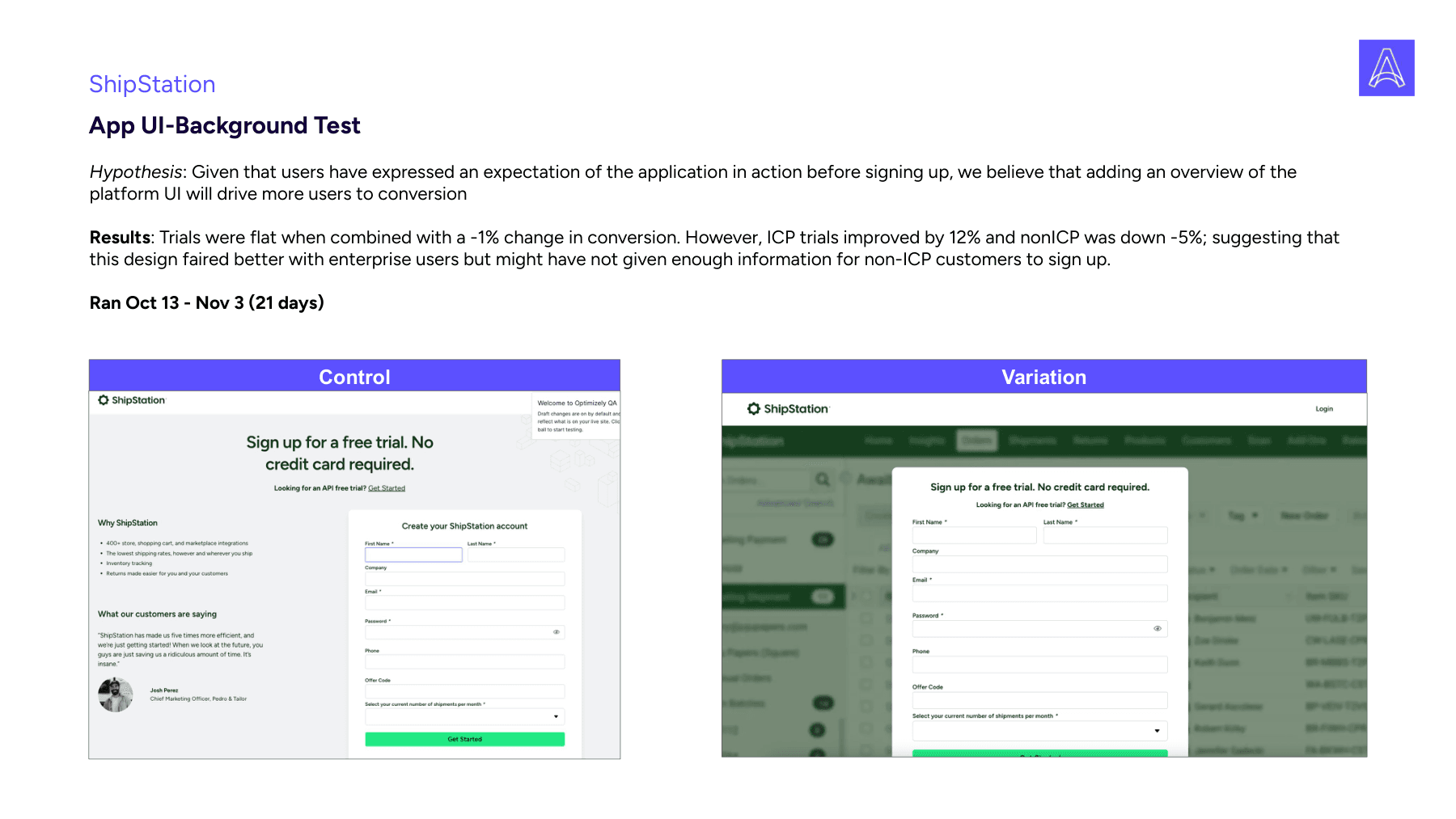
App UI Background Test
Oct 13 – Nov 3, 2025 · 21 days
Hypothesis
Surfacing the platform UI in the hero would answer the pre-signup question enterprise users bring: what does this actually look like to use?
Results & Learning
Flat overall (-1% combined). ICP trials up +12%, non-ICP down -5%. The design worked for enterprise buyers who valued software evidence; smaller businesses needed social proof and simplicity instead. Hardened the ICP/non-ICP segmentation as a durable testing framework.
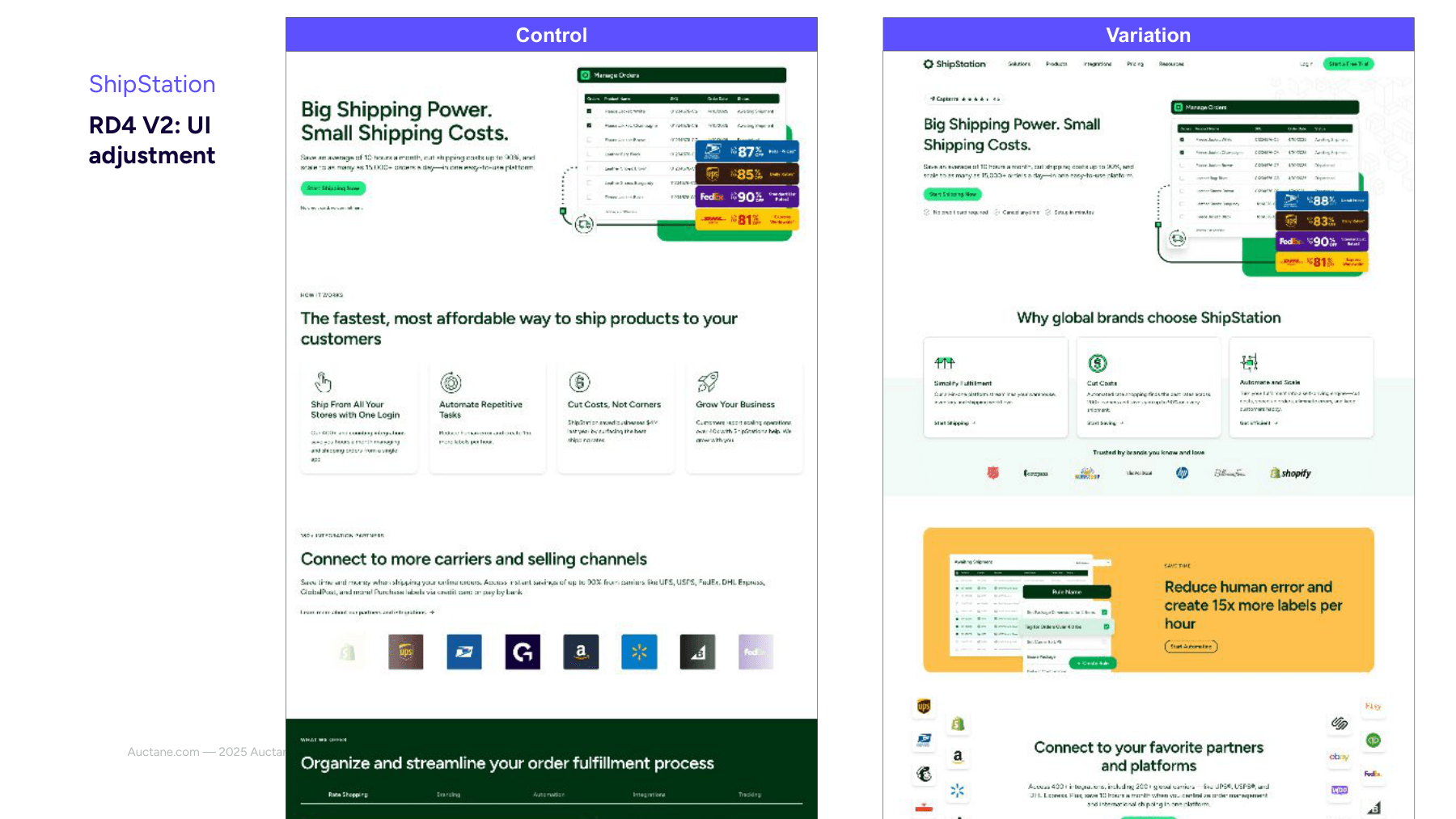
RD4 V2: UI Adjustment
Nov 4 – Nov 24, 2025 · 19 days
Hypothesis
"Start Shipping Now" had performed well in control. Pairing it with improved visual contrast and the "Shipping Power" copy from the multi-headline test would drive overall lift.
Results & Learning
+4% trials overall (ICP +2%, non-ICP +5%). Direct traffic bucked the trend: -8.7% overall, ICP -10%, non-ICP -6%. Identified direct as a distinct audience requiring its own dedicated LP rather than further global optimizations.
ShipStation: Trial Page
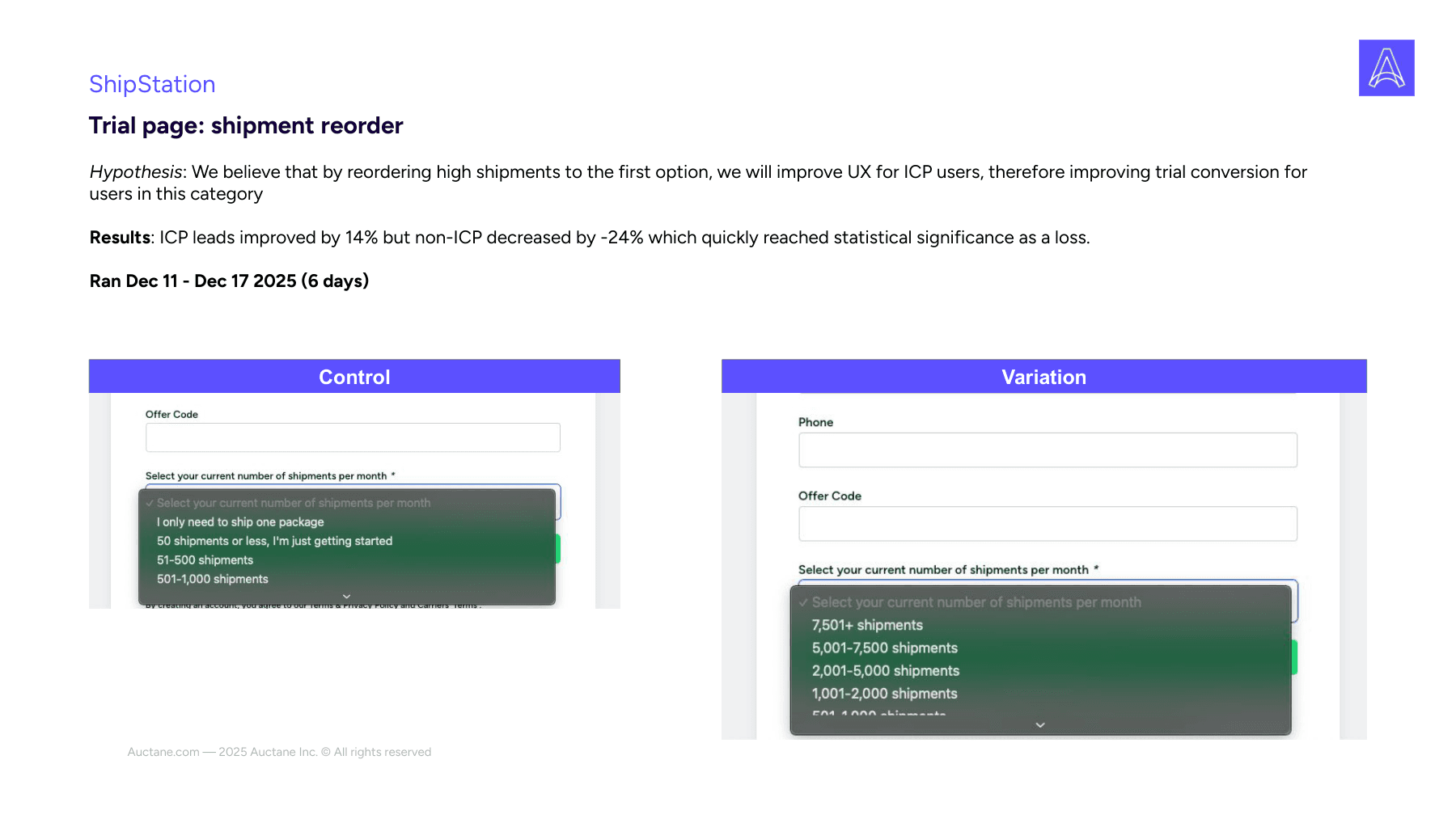
Shipment Volume Reorder
Dec 11 – 17, 2025 · 6 days
Hypothesis
Surfacing high-volume shipment options (7,500+) at the top of the volume selector would better serve ICP users who self-identify there.
Results & Learning
Stopped after 6 days when non-ICP loss hit statistical significance at -24%. ICP leads were up +14%, but allowing the test to keep running would have burned real volume. The data was unambiguous: a single field change can't serve both audiences. The right solution is a conditional form experience that qualifies enterprise users without adding friction for everyone else — a finding that reshaped how subsequent trial page work was scoped.
Stamps.com: Homepage
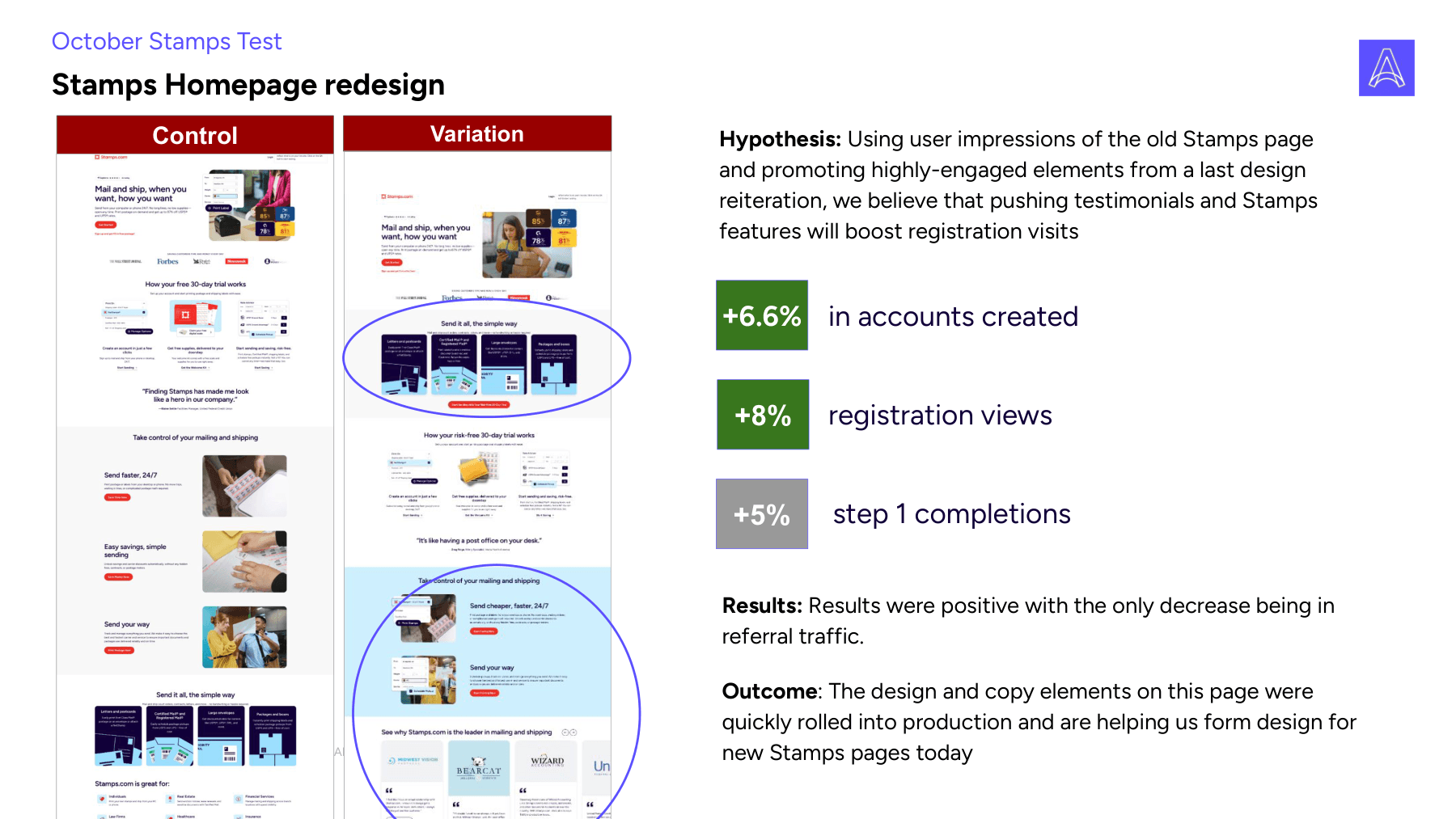
Homepage Redesign, Part 1
October 2025 · 20 days · 491K visitors
Hypothesis
Promoting high-engagement elements (testimonials and product feature sections) to the top of the page would drive more users into the WebReg registration flow.
Results & Learning
+6.6% accounts created, +8% registration views, +5% Step 1 profile completions. The only segment that did not improve was referral account creation. Design and copy elements were shipped directly to production and are forming the foundation for all subsequent Stamps.com page redesigns.
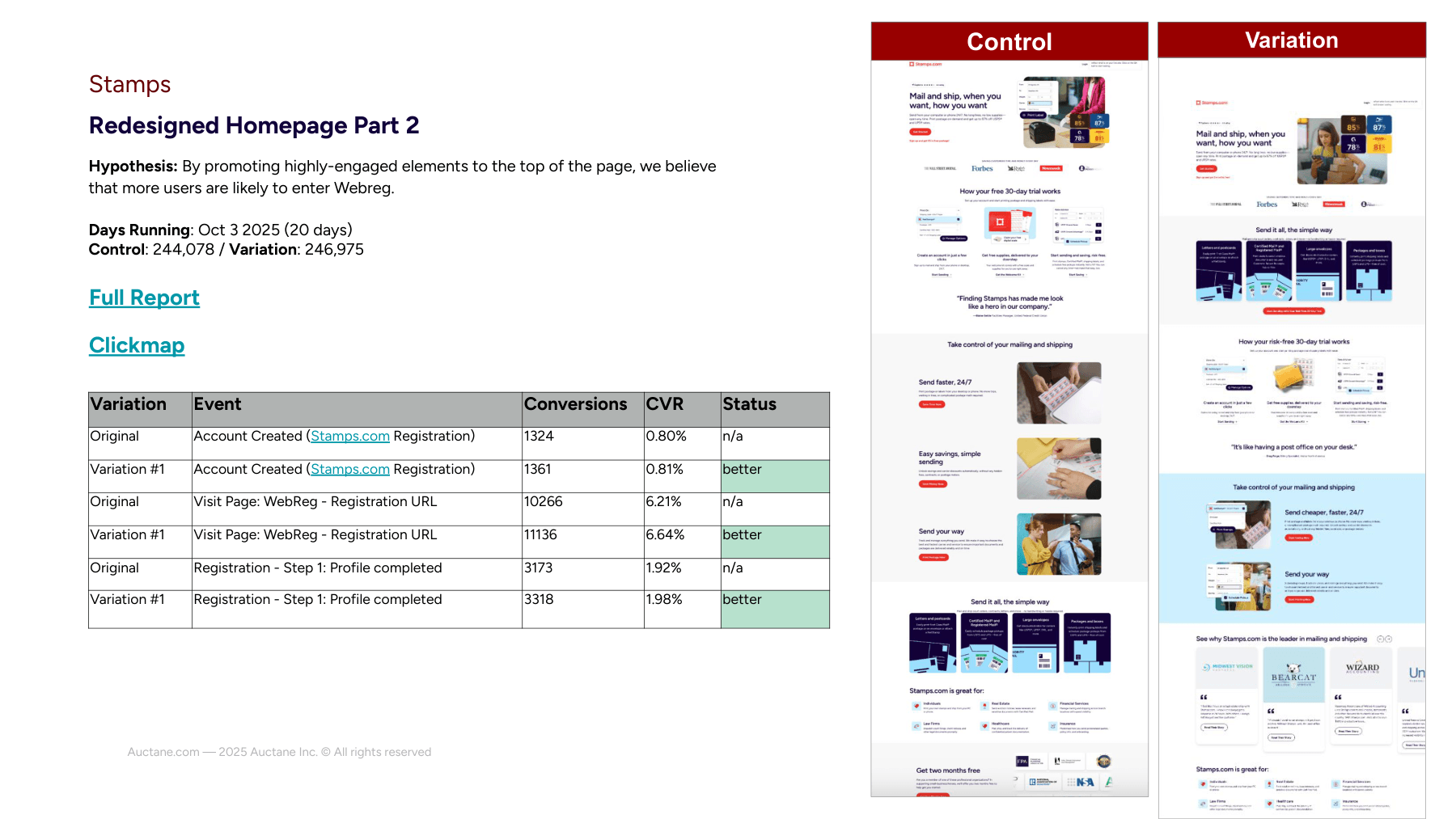
Homepage Redesign, Part 2
Oct 3, 2025 · 20 days · 491K visitors
Hypothesis
Promoting additional highly-engaged elements higher on the page would compound the gains from Part 1.
Results & Learning
Consistent improvements across all funnel metrics: accounts created 0.80% → 0.81%, WebReg visits 6.21% → 6.64%, Step 1 completions 1.92% → 1.98%. Referral account creation slightly regressed (0.97% → 0.93%). Demonstrated that incremental iteration on an already-winning design continues to compound.